What Is Org Planning? A Practical Guide (and Where Succession Planning Fits)
A precise guide to org planning: definitions, the five-step process, span-of-control benchmarks, and where succession planning fits.

Org planning is the ongoing process of matching your organization's structure, headcount, and roles to its strategy. It covers who reports to whom, how teams are sized, where new roles get added, and how the structure should change as the business changes. Succession planning is a related but narrower discipline: preparing people to fill critical roles when they open up.
The two get confused constantly, and the confusion is expensive. A company that treats a succession spreadsheet as its org plan will be blindsided by structural problems no successor can fix. A company that redraws boxes without asking who could fill them is planning an org it can't staff.
This guide defines the terms precisely, lays out a five-stage org planning process we call the Baseline-First cycle, gives you the benchmark numbers planners use, and explains the prerequisite most articles skip: none of this works if your underlying org data is wrong.
What is org planning?
Org planning (organizational planning) is the continuous practice of designing and adjusting a company's structure, reporting relationships, team sizes, and headcount so they support the business strategy.
It produces decisions: where to add roles, where to consolidate teams, how many direct reports a manager should carry, and what the organization should look like in 6, 12, and 18 months.
The word "continuous" is doing real work in that definition. A reorg is an event. Org planning is the discipline that makes reorgs smaller, rarer, and less painful, because structural problems get caught and corrected while they're still cheap to fix.
In practice, org planning answers questions like these:
- Which managers are carrying too many direct reports to manage well, and which layers exist without adding value?
- If we win the deal, enter the market, or double the engineering team, what does the structure need to look like, and by when?
- Which teams should the next 20 hires join, and what does that cost?
- Does today's structure reflect where the company is going, or where it was two years ago?
Org planning, org design, workforce planning, succession planning: what each term means
HR, Finance, and department heads use these terms interchangeably in meetings, and each function quietly means something different. Here is the precise breakdown.
| Discipline | Core question | Typical owner | Primary output |
|---|---|---|---|
| Org planning | Does our structure and headcount match our strategy, now and 18 months out? | Shared: CHRO, CFO, department heads | Structural decisions and headcount scenarios |
| Org design | How should teams, roles, and decision rights be structured? | HR / leadership, often with consultants | A target structure and operating model |
| Workforce planning | Will we have the people and skills the business needs over time? | HR, with Finance | Capacity, skills, and hiring forecasts |
| Headcount planning | How many people, in which roles, at what cost, against which budget? | Finance, with HR | An approved headcount budget |
| Succession planning | If a critical role opened tomorrow, who could step in, and how ready are they? | CHRO and the board (for executive roles) | Successor pipelines and development plans |
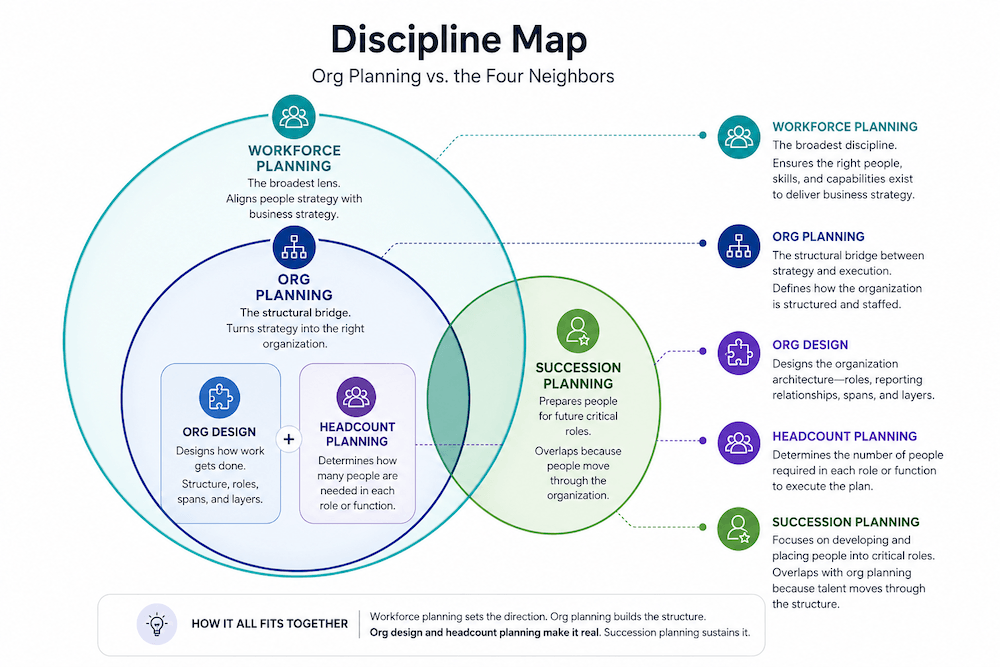
The relationships matter as much as the definitions. Org design is a sub-discipline of org planning focused on structure. Headcount planning is the financial expression of org planning. Workforce planning is the umbrella that includes all of it plus skills and recruiting forecasts. If you're new to structural terms, our guide to making sense of organizational structures covers the foundations.
How is org planning different from succession planning?
Org planning designs the roles; succession planning prepares the people who will fill them. Org planning asks whether the structure itself is right. Succession planning assumes the role exists and matters, then asks who could take it over and what development would get them ready.
Three differences separate them in practice:
Scope. Org planning covers the whole structure: every team, layer, and reporting line. Succession planning targets a specific set of critical roles, usually executives plus the handful of positions where a sudden vacancy would cause serious damage.
Time horizon and trigger. Org planning runs on business cadence: strategy shifts, growth, budget cycles. Succession planning runs on people risk: retirements, resignations, promotions, and the readiness of internal candidates.
Output. Org planning produces structural decisions with costs attached. Succession planning produces a pipeline: named candidates, honest readiness ratings, and development plans that close the gaps.
Org planning and succession planning intersect at scenario modeling. When a succession event happens, the org changes, and a good org plan already models what that change looks like. When an org plan eliminates or reshapes a role, the succession plan for that role needs to change too. Companies that run the two disciplines in separate tools, on separate data, discover these dependencies at the worst possible moment.
The cost of getting succession wrong is well documented. Harvard Business Review researchers estimated that poor CEO succession and the churn it causes wipe out close to $1 trillion a year in market value among the S&P 1500 alone. Further down the org, most companies remain exposed: SHRM found only 21% of HR professionals report having a formal succession plan, and 56% have none at all, while Gallup found most small-business owners have no succession plan either.
The org planning process: the Baseline-First cycle
Most definitional articles stop before the part that matters: how you do this. A working org planning process has five stages. We call it the Baseline-First cycle, because the four later stages inherit whatever accuracy the first one gives them.
1. Establish an accurate baseline
Pull the real current state: every role, reporting line, team, location, and cost. This step kills more org plans than any other, because in most companies the official org chart lags reality by weeks or months. People change managers, teams split, contractors come and go, and the chart doesn't move. The gap is measurable: in OneDirectory's analysis of real Microsoft 365 tenant data, only 42% of employees have a completed Manager field in Entra ID, so the average system of record is missing more than half of its reporting lines. We've written about the battle to maintain an accurate org chart; org planning is where losing that battle gets expensive. Planning against a stale baseline means every scenario downstream is wrong before you start.
2. Diagnose the current structure
Score the baseline against a small set of structural health measures: spans of control by team, number of management layers between the CEO and the front line, single points of failure, duplicated functions, and roles whose purpose nobody can state. Comparing what you find against your intended organizational design usually surfaces the gap between the structure leadership believes it has and the one that exists.
3. Model future-state scenarios
Build 2-3 structural scenarios against the strategy: the growth case, the flat case, the downside case. Each scenario should specify team structures, leadership needs, headcount, and fully loaded cost. This is where Finance and HR need to work from the same numbers. A scenario without costs is a drawing; a budget without structure is a guess.
4. Decide, sequence, and communicate
Pick the target structure and sequence the moves: which changes happen this quarter, which wait for a hire or a product milestone, and who is told what, when. Sequencing is where reorgs earn their bad reputation. McKinsey's research on organizational redesign found that 82% of executives have been through a redesign, and most expect another within two years, yet historically fewer than a quarter of these efforts fully succeeded. Execution and communication, not the paper design, are where they fail.
5. Monitor and adjust continuously
Review the structure against the plan on a fixed cadence, quarterly for most companies. Watch spans drifting up, layers creeping in, and teams outgrowing their design. The goal is small corrections often, instead of a traumatic rebuild every three years.
The numbers org planners steer by
Org planning gets more useful the moment you attach numbers to it. These are the benchmarks worth knowing:
- Span of control. Gallup's analysis of more than 20,000 managers found manager engagement peaks at 8-9 direct reports. Typical healthy ranges run 6-8 for knowledge work and 15-25 for standardized operational roles. A span far below the range suggests an unnecessary layer; far above it suggests a manager who has stopped managing.
- Manager load. Three-quarters of the 805 HR leaders Gartner surveyed in 2024 said their managers are overwhelmed by the growth of their responsibilities. Spans that looked fine three years ago may not be fine now.
- Reorg frequency and success. Most executives sit inside a redesign every two years. McKinsey's 2025 research found execution improving, with 63% of recent redesigns meeting most objectives, against roughly 20% a decade earlier. The differentiator was disciplined implementation, not cleverer structures.
- Layers. Every management layer between the CEO and the customer adds decision latency and cost. Counting them per function, and asking what each one decides, is the fastest structural diagnostic there is. See our breakdown of flat vs vertical hierarchy for the trade-offs.
The prerequisite: org planning runs on org data
A pattern shows up in almost every failed org plan, and it has nothing to do with strategy. The planning happened on data that was wrong. HR modeled scenarios in one spreadsheet, Finance budgeted headcount in another, and neither matched the actual organization. By the time the plan reached department heads, people had already moved, and the plan described a company that no longer existed.
The scale of the problem shows up in OneDirectory's State of Employee Directories in 2026, an analysis of years of real Microsoft 365 and Entra ID tenant data. Employee profiles averaged 31% complete. Only 42% of employees had a completed Manager field, meaning the reporting lines an org plan depends on were missing for more than half the workforce. And only a third of organizations cleared even a 60% completion bar on core profile fields. A baseline pulled from a directory in that state produces a plan with the same holes.
Accurate org planning needs three things from its data layer:
- A live picture of the current org. Reporting lines, teams, and locations that update when reality changes, not when someone remembers to edit a chart. That starts with knowing what an org chart is actually for and treating it as operational data rather than a poster.
- Complete people profiles. Skills, tenure, and role information deep enough to answer succession questions. You can't assess pipeline readiness for a role if you can't see who has which skills today.
- One source of truth shared across HR, Finance, and department heads. The moment each function maintains its own copy, the copies diverge, and meetings turn into arguments about whose numbers are right.
Tooling follows the same logic. An org chart shows current state; org planning tools model future states. Both depend on the same underlying people data, and the quality of that data decides whether either is useful. Our guide to choosing org chart software covers what to look for in the visualization and data layer, and the strategic uses for org charts shows how far an accurate one can take you before you need dedicated planning software.
Frequently asked questions
What is org planning in simple terms?
Org planning is deciding, on purpose and on a regular cadence, how your company should be structured: who reports to whom, how big teams should be, where the next hires go, and how the structure changes as strategy changes.
Is succession planning part of org planning?
They overlap but neither contains the other. Org planning designs roles and structure; succession planning builds the pipeline of people ready to fill critical roles. A succession event triggers an org change, and an org change can rewrite a succession plan, so mature companies run them on shared data.
What is the difference between org planning and org design?
Org design is the sub-discipline of org planning that decides how teams, roles, and decision rights should be structured. Org planning wraps that design work in the ongoing decisions around headcount, cost, and timing. Every org design produces an org plan to implement it.
What is the difference between org planning and workforce planning?
Workforce planning is the broader discipline: aligning people capacity to business demand over time, including skills forecasting and recruiting pipelines. Org planning is the structural core of it, focused on reporting relationships, team design, and headcount distribution.
What is an example of org planning?
A 400-person company decides to double its sales team in 12 months. Org planning determines whether to split the team by region or by segment, how many managers to hire so spans stay near eight, whether a VP layer is needed and when, and what each option costs fully loaded. The output is a sequenced plan Finance and HR both signed off on.
What tools do companies use for org planning?
Most start with spreadsheets and HRIS exports, move to org chart software once org visibility matters, and adopt dedicated planning platforms when they need cost-loaded scenario modeling. The tool matters less than the data feeding it: planning on a stale export produces a stale plan.
How often should org planning happen?
Continuously, with a quarterly structural review and a deeper annual cycle tied to budgeting. Major redesigns still happen every 2-3 years at most companies, but the point of continuous planning is to make each one smaller.
Who owns org planning?
No single function can. HR owns people outcomes and succession, Finance owns cost and headcount budgets, and department heads own structure within their functions. It works when all three plan against the same live org data, and stalls when each runs its own version.
What is the difference between an org chart and an org plan?
An org chart shows the organization as it is. An org plan is a set of decisions about what it should become, with scenarios, costs, and a sequence for getting there. The chart is the input and the scoreboard; the plan is the work.
Where to start
Skip the software evaluation for a week and audit your baseline instead. Export your current org data and check it against reality: reporting lines, team assignments, open roles, manager spans. Count the corrections you have to make. That number tells you whether you're ready to plan, and it usually explains why the last plan didn't stick.
Structure follows strategy, but planning follows data. Get the picture of your organization accurate and current first. Every discipline in this article gets easier from there.